Why Yuma's Salt Cells Fail Faster Than the National Average
Why Yuma's Salt Cells Fail Faster Than the National Average
Yuma's water hardness regularly exceeds 300 ppm calcium carbonate — among the highest readings in the continental U.S. — and that single fact changes the math on salt cell life in Yuma more than any other variable. A cell rated for five years somewhere like Portland might survive four in Phoenix and three in Yuma, simply because the plates are fighting a constant calcium plating problem that softer-water climates never see. If your salt system has been running here without a structured descaling schedule, this post explains exactly what's happening inside that cell and what you can do about it.
What calcium does to a salt cell's plates
A salt cell works by passing pool water across titanium plates coated with a ruthenium or iridium oxide layer. When electrical current runs through the plates, dissolved salt (sodium chloride) converts to chlorine gas, which then dissolves into the water as hypochlorous acid — the active sanitizer. The process is continuous and relatively efficient, assuming the plates stay clean.
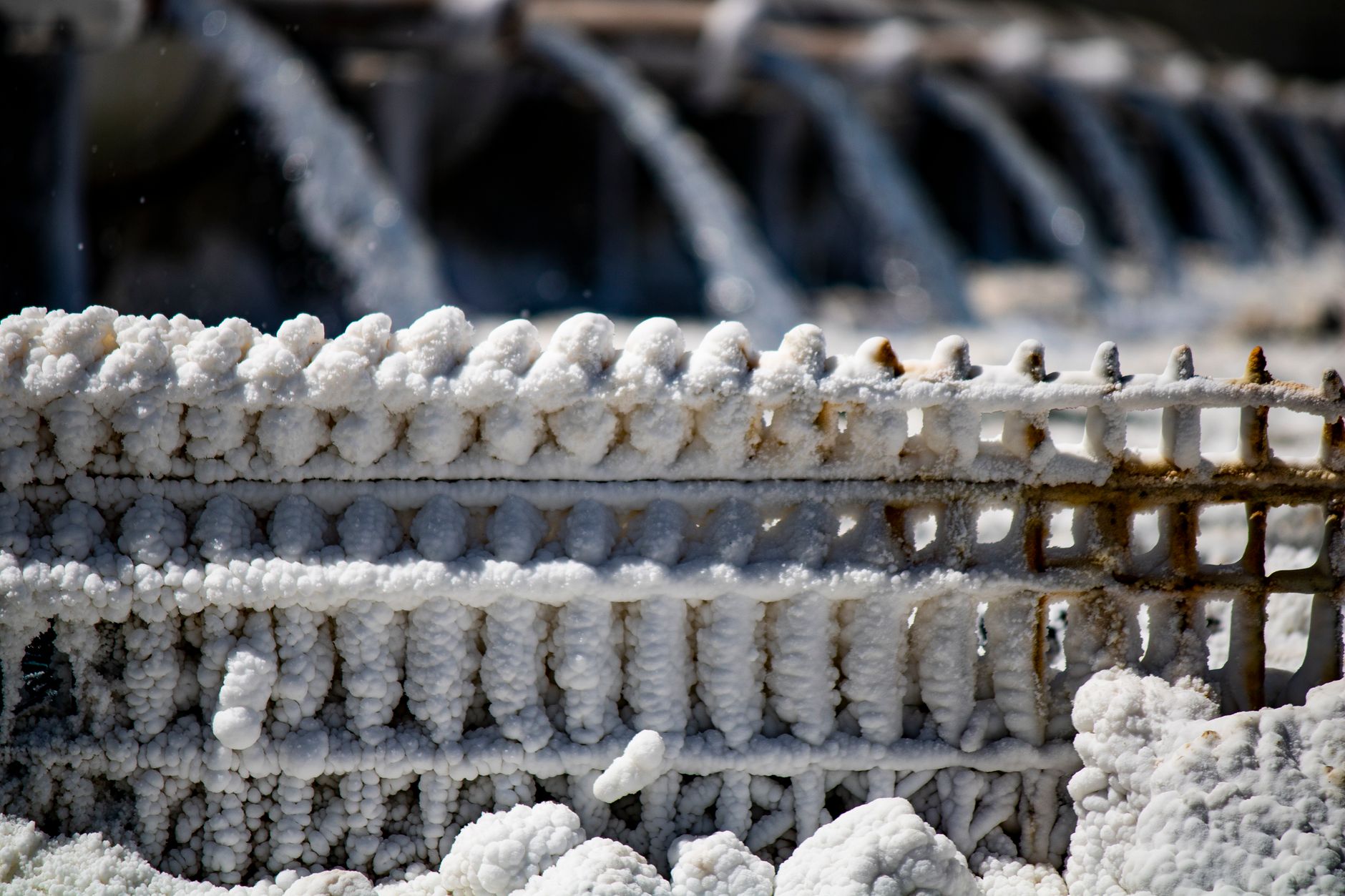
Hard water disrupts that process at the surface level. Calcium carbonate precipitates out of solution when it contacts the charged plates, forming a white, chalky scale layer that insulates the plate surface from the water. The cell has to work harder to push the same chlorine output through an increasingly thick mineral barrier. Over time, the oxide coating on the plates degrades faster under that thermal and electrical stress — and once the coating is gone, the plate is spent.
In Yuma, this happens on a compressed timeline. The combination of extreme heat, high calcium content, and the elevated pH that hot water naturally drives creates near-ideal conditions for rapid scale formation. Yuma's water hardness sits at levels that equipment manufacturers simply didn't design their rated lifespans around.
How Yuma's climate accelerates the problem
Water temperature is the amplifier most homeowners don't account for. Calcium carbonate becomes less soluble as water temperature rises — the opposite of what most people would guess. That means a Yuma pool running at 88°F to 92°F in June actively pushes calcium out of solution and onto any surface with an electrical charge, which is your salt cell.
Mid-June is when chlorine demand hits its annual peak. The water is at its hottest, bather load is up, and UV index in Yuma is among the highest in the country. A salt cell that's been scaling quietly since March is now being asked to run at maximum output — and it's doing it with plates that are partially insulated by calcium deposits. The shortfall shows up fast. A pool that was holding 3 ppm free chlorine in May might struggle to reach 2 ppm by mid-June despite no change in run time or settings.
After 55 years working pools in this climate, we've seen this pattern enough times to recognize it on the first service call — low chlorine, correct salt reading, a cell that looks fine from the outside but is caked on the plates.
The 90-day descaling cadence
The national default recommendation for salt cell cleaning is every three to six months. In Yuma, six months is too long. We descale cells on our Premium and Elite plans every 90 days because at Yuma's hardness level, that's the interval that keeps cell output consistent and extends plate life measurably.
The cleaning process itself is straightforward: remove the cell, inspect the plates visually, soak in a diluted muriatic acid solution to dissolve the calcium deposits, rinse, reinstall, and verify output with a free chlorine test. The inspection step matters — a cell with visible plate damage or coating wear isn't going to recover from a cleaning. It needs salt cell replacement.
Skipping cleanings doesn't just shorten cell life; it creates a feedback loop. A scaled cell runs at reduced efficiency, so the control board compensates by increasing the percentage output setting. Running a cell at 90–100% to compensate for scaling accelerates the oxide coating degradation on the plates. The cell that might have lasted four years with quarterly cleaning can fail in two years running at maximum output to fight scale.
Cell life depends on use, water chemistry, and Yuma's hard water. Replacement is typical at 3 to 7 years, but the difference between landing at three years and landing at six years is almost entirely maintenance-driven.
Signs your salt cell is losing the battle
The earliest signal is low free chlorine that doesn't respond to increasing run time. If your system is set to run eight hours and you're seeing 1 ppm at the end of the day in June, that's a cell performance issue until proven otherwise.
Control panel warnings are the next indicator — specifically, a low-salt alert when you've tested the water and confirmed salt levels are within range. The cell isn't reading salt accurately because the scale layer on the sensor end is interfering with conductivity. Some controllers will also show a "check cell" or "inspect cell" light, which is the system telling you directly that something is off.
If you pull the cell and find white, powdery deposits between the plates, you're looking at calcium scale. If you find brown or gray discoloration on the plates themselves, that's oxidation of the coating — a sign the cell is past cleaning and approaching end of life. Our pool equipment repair team can tell you which situation you're dealing with after one inspection.
When to replace versus clean
Cleaning is the right call when the plates are intact and the deposit is calcium-only — soft, white, and responsive to acid. Replacement is the right call when:
- Plates show visible physical damage, pitting, or flaking
- The oxide coating has a brown, worn appearance across multiple plates
- The cell consistently fails to produce adequate chlorine within a week of cleaning
- The cell is past five years old and showing any of the above
Salt cell replacement on the systems we service in Yuma generally runs between about $2,500 and $4,000, parts and labor together, depending on whether your system needs the cell alone or the cell plus the control board and power center, and on the brand and model. Generic aftermarket cells cost less and are the fastest way to void the warranty on the system they plug into, so we install the manufacturer's cell. We provide a written estimate before any work begins — the service call fee is credited toward the repair if you approve the work, and if the cell is still under manufacturer warranty we handle the claim.
Green Valley Pool Service & Repair is voted Yuma's Best by Yuma Sun Reader's Choice 11 separate times since 2001, and a significant part of that reputation comes from being straight with homeowners about what actually needs replacing versus what just needs cleaning. We don't upsell a new cell when a cleaning solves the problem.
For homeowners looking at a full pool service in Yuma with a salt system, the descaling schedule is non-negotiable in our service plan structure. It's built into our maintenance visits because the alternative — reactive replacement every two to three years — costs more over time and leaves you with an underperforming pool during the summer months when you need it most.
Frequently Asked Questions
How long does a salt cell last in Yuma, Arizona?
A salt cell is rated for 3 to 7 years under typical conditions. In Yuma, where water hardness regularly exceeds 300 ppm calcium carbonate, most cells land at the short end of that range — or fall short of it entirely — without a consistent descaling schedule every 90 days.
How often should I descale my salt cell in Yuma?
Every 90 days. Yuma's hard water deposits calcium on cell plates faster than nearly anywhere else in the country. Waiting six months between cleanings — the schedule that works in softer-water markets — lets scale build to the point where it permanently reduces cell output and shortens hard water salt cell lifespan.
What are the first signs a salt cell is failing in a desert climate?
Low free chlorine despite the system running normally is the earliest signal. You may also see the control panel display a low-salt warning even after you've verified salt levels are correct. Visible white calcium deposits on the cell plates confirm scaling. In mid-summer Yuma heat, a failing cell becomes obvious fast — chlorine demand is at its peak and the shortfall shows up within days.
Is salt cell replacement in Yuma covered by home warranty plans?
Coverage varies by warranty provider and policy terms. Green Valley Pool Service & Repair is an authorized service provider for most major home warranty companies. We can diagnose the cell, document the failure, and work directly with your warranty company — though we cannot guarantee your specific plan will approve the claim.
If your salt system is struggling to hold chlorine this summer, the cell is the first place to look. We pull it, inspect it, and give you a written answer on whether cleaning or replacement is the right call — before any work begins. Schedule a diagnostic through our residential service options or call us directly at (928) 597-9196.